Reminderly.ai vs Tasks.Bot for Google Sheets Automation AI
Spreadsheet reminders break the moment your team leaves the desk. Field crews miss deadlines that live in rows they never open, and task updates get buried in chat threads nobody checks. This comparison shows what actually changes when automation moves into WhatsApp.
You will learn how Tasks.Bot handles Google Sheets style tracking without the spreadsheet, how it compares to Reminderly.ai, and which features matter for field teams: natural language task creation, voice notes, GPS tracking, and face verified attendance. You will also see pricing, beta status, and a clear verdict on who should switch.
What Is Tasks.Bot? WhatsApp-Native Task Management Explained
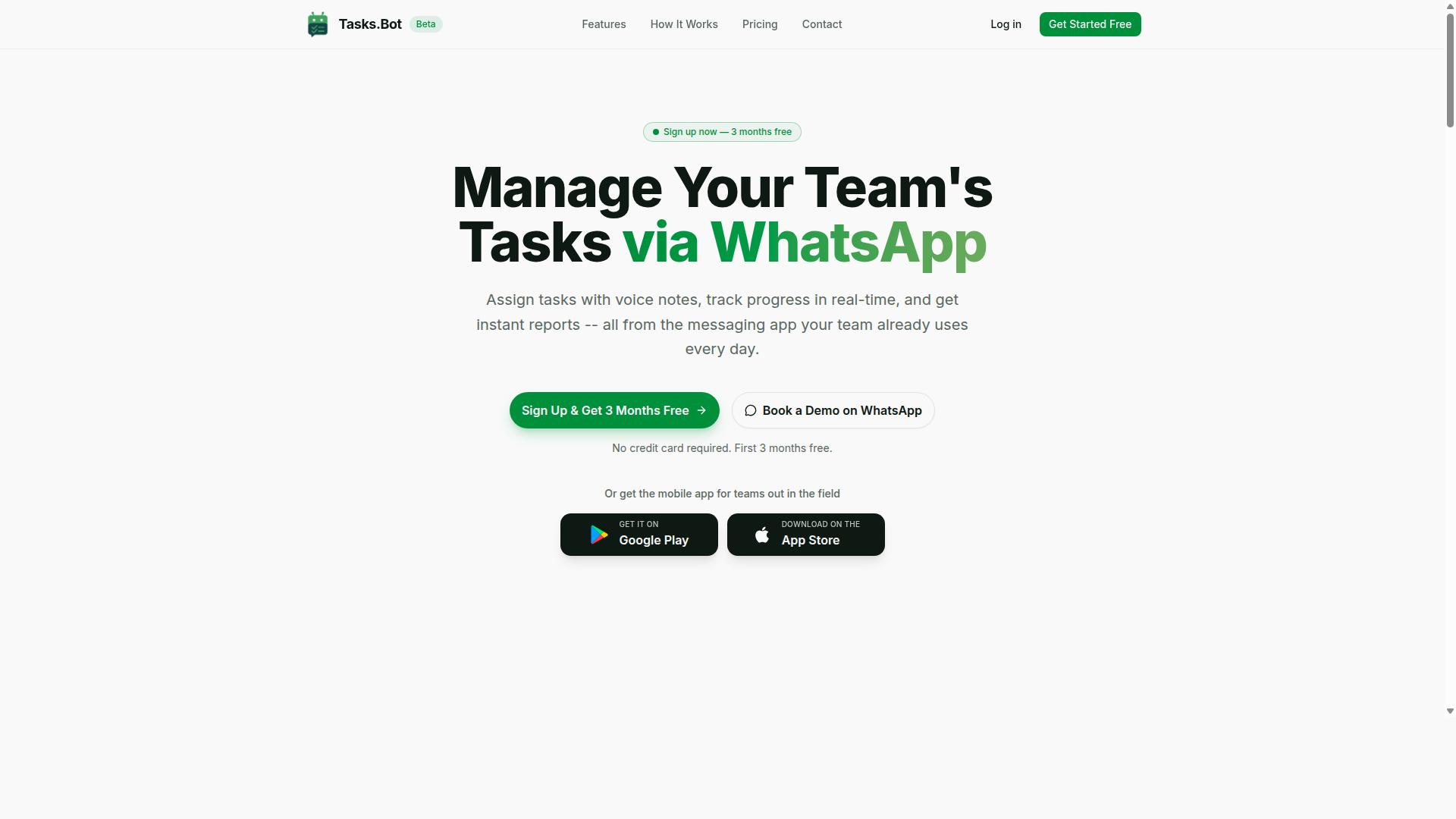
Tasks.Bot is a task management platform that operates entirely within WhatsApp, eliminating the need for teams to adopt yet another standalone app. Team members assign tasks, track progress, and receive reports without leaving the messaging app they already use every day.
The core value proposition is simple: no new accounts or installations are required for team members to get started. Because everything runs inside WhatsApp, adoption friction drops dramatically compared to traditional project management tools.
For teams working away from a desk, Tasks.Bot also offers a mobile app for field teams, available on Android and iOS with push notifications, voice capture, and a home screen widget. The service is currently in beta and offers a free trial period, so teams can explore its capabilities before committing.
How Tasks.Bot Handles Google Sheets-Style Task Tracking and Automation
While Tasks.Bot doesn't directly connect with Google Sheets, it offers task tracking through a conversational interface within WhatsApp.
The difference is how tasks get created. Instead of typing into cells, users can create tasks via natural language or voice notes, and the system uses AI to understand intent and create tasks from messages.
Automations extend this further. Tasks.Bot offers approvals and automations, which covers much of what teams build with spreadsheet formulas, conditional logic, or Google Apps Script. The trade-off is clear:
- No manual formulas or scripts needed to keep tasks organized
- No direct export to Sheets, so data stays within WhatsApp and the mobile app
- Reminders and alerts arrive as WhatsApp messages rather than email reminders or SMS notifications
For teams weighing Reminderly.ai against Tasks.Bot for Google Sheets automation, the distinction matters. Tasks.Bot is not a spreadsheet add-on or extension, it is a WhatsApp-native chatbot built around conversational task management. Teams that want spreadsheet-style structure without spreadsheet maintenance often find that trade-off worthwhile.
Is Tasks.Bot a Strong Alternative to Reminderly.ai for Google Sheets Automation?
Tasks.Bot and Reminderly.ai both aim to automate task reminders, but they take fundamentally different approaches: one is WhatsApp-native, the other is built around Google Sheets. Understanding that split is the key to choosing between them.
The honest answer is that Tasks.Bot is not a like-for-like replacement for a Google Sheets automation tool. It is a conversational alternative for teams who live in messaging apps rather than spreadsheets. If your workflow depends on spreadsheet formulas and cell-level triggers, a Sheets-first tool will feel more natural. If your team coordinates through chat, the calculation changes.
Neither platform is universally better. The right pick depends on where your tasks already live and how your people prefer to interact with them.
| Dimension | Tasks.Bot | Reminderly.ai |
|---|---|---|
| Primary platform | WhatsApp-native chatbot | Google Sheets add-on |
| Setup style | No-code, conversational | Spreadsheet formulas and triggers |
| Interaction model | Natural language, voice notes | Email and SMS reminders |
| Best fit | Field and mobile teams | Office-based, Workspace-centric teams |
Platform and interaction. Tasks.Bot meets users inside WhatsApp, so reminders arrive where people already read messages. Reminderly.ai sits inside Google Sheets, where task rows, due dates, and status columns are managed. One is chat-first, the other is document-first.
Ease of use. A no-code chatbot lowers the barrier for people who dislike spreadsheets. A Sheets add-on rewards users who are already comfortable with formulas, conditional logic, and Google Apps Script.
Features and audience. Voice notes and natural language processing suit hands-on, on-the-go workers. Email and SMS reminders suit desk-based teams that track deadlines in rows and columns. This is why Tasks.Bot tends to appeal to field teams, while Reminderly.ai fits organizations deeply embedded in Google Workspace.
For a fuller picture, weigh how your team already communicates, how much setup effort you can absorb, and whether your tasks originate in a spreadsheet or in conversation. Teams that answer "chat" will find Tasks.Bot a strong fit. Teams that answer "spreadsheet" may prefer a Sheets-native tool. Both are valid, and the choice comes down to workflow, not winner-takes-all.
Key Features and What Makes Tasks.Bot Stand Out
Tasks.Bot packs a surprising range of capabilities into a WhatsApp-first interface, from AI-powered task creation to field team management tools.
What separates Tasks.Bot from a typical Google Sheets add-on is where it lives. Instead of asking teams to open a spreadsheet or install another app, it runs entirely inside WhatsApp, a tool most teams already use every day.
The platform combines AI that understands natural language with automatic task assignment, smart deadline reminders, approvals, and instant reports. It also includes tasks on a map, a live day tracker, face-verified attendance, and shifts, leave, and hours management.
The sections below break down each capability in detail.
AI Task Creation via Natural Language and Voice Notes
Tasks.Bot uses AI to interpret natural language and voice notes, turning casual messages like "Remind Sarah to submit the report by 5 PM" into structured tasks with assignees and deadlines.
The system uses AI to understand user intent and create tasks from messages. A message such as "Send invoice to client tomorrow" becomes a dated task assigned to the right person. A voice note saying "Book meeting with marketing team next Monday at 10 AM" works the same way.
The biggest advantage is the lack of friction. There are no forms to fill, no dropdown menus to navigate, and no new interface to learn. Team members simply type or speak the way they already do in a chat thread.
Once the AI extracts the details, Tasks.Bot handles the rest. Tasks are automatically assigned to the right person, and reminders are set based on the deadline mentioned in the message.
For teams comparing options, this matters when weighing Tasks.Bot against tools like Reminderly.ai that lean on spreadsheet formulas and script-based triggers. Natural language input removes the setup burden that often slows adoption of any Google Sheets automation workflow.
Automations, Smart Deadline Reminders, and Instant Reports
Tasks.Bot automates the follow-up process with smart deadline reminders that adapt to task status, and generates instant reports on demand.
Automation covers more than a single reminder. Tasks can be assigned automatically as they are created, recurring tasks repeat on schedule, and conditional logic can trigger an escalation when something is not completed by its due date. Approvals are built in as well, so a manager can sign off on work without leaving the chat.
Reminders arrive as WhatsApp push notifications, which keeps alerts in the same thread where the work was assigned. Because the reminders respond to task status and urgency, overdue items get attention while completed work stops generating noise.
Reporting works on request. A user can ask for something like "Show me all overdue tasks" or "Weekly progress summary" and receive the answer immediately in WhatsApp. There is no dashboard to open and no report to export first.
This on-demand model changes how teams handle deadline tracking. Instead of checking a spreadsheet each morning, managers get a current picture the moment they ask. The same automations that power reminders can also trigger alerts when a task stalls, which keeps project management moving without manual check-ins.
Field Team Tools: GPS Tracking, Face-Verified Attendance, and Live Day Tracker
For teams with field staff, Tasks.Bot offers GPS tracking, face-verified attendance, and a live day tracker to monitor progress in real time.
GPS tracking shows managers where field staff are located when they check in or complete a task. Face-verified attendance uses facial recognition to confirm identity at check-in, which helps prevent buddy punching and keeps attendance records accurate.
The live day tracker provides a timeline of activities and task completions across the working day. Together, these tools connect directly to task management. When a field agent marks a task complete, the system records the time, location, and photo verification in one step.
These features are available through the Android and iOS apps, which also support push notifications, voice capture, and a home screen widget. That means field staff can work from a phone without opening a spreadsheet or logging into a desktop system.
The benefits show up in three areas:
- Accountability, since check-ins and completions carry verified time and location data
- Payroll-ready hours, with attendance and shift records captured as work happens
- Efficiency, because managers see progress without chasing updates by phone or message
Shifts, leave, and hours management round out the field toolkit, giving teams a single place to track who worked, when, and where.
Pricing and Plans
Tasks.Bot offers a single 'Full Access' plan with all features included, priced per member per month or annually. There are no tiers to compare, no feature gates, and no upgrade decisions to make before your team can start automating Google Sheets workflows.
Pricing is available in Indian Rupees (₹) and US Dollars ($). The site displays a 'Select currency' option with both choices, so you can confirm the correct currency before you commit.
The structure is straightforward:
- Monthly plan: ₹200 per member per month
- Annual plan: ₹1,200 per year per member, which works out to a 50% saving of ₹1,200 per year per member
For a team of 10, that means ₹2,000 per month or ₹12,000 per year. The annual route cuts the effective cost per member roughly in half compared with paying month to month.
Because every feature sits inside the same plan, the only real decision is billing frequency, not which capabilities your team gets access to. That matters for Google Sheets automation, where reminders, notifications, and scheduling all need to work together rather than being split across separate paid add-ons.
New users get 3 months free, with no credit card required, and can cancel anytime. A refund policy is also mentioned in the site footer, so it is worth reading before purchase.
For teams weighing this against other spreadsheet automation options, the flat per-member rate keeps budgeting predictable as headcount grows. A five-person team pays ₹1,000 monthly or ₹6,000 annually, and the same per-member math scales cleanly from there.
Pricing details can change over time, so confirm current rates on the official site at the moment of purchase rather than relying on older figures.
Trust Signals: Beta Status, Encryption, and Teams Already Using It
Tasks.Bot is currently in beta, but it already supports hundreds of teams and employs encryption to protect data. For anyone weighing whether to trust a newer automation tool with their Google Sheets workflows, that combination matters. Beta status usually signals active development rather than an unfinished experiment, and the site's claim of hundreds of teams suggests real usage behind the product.
Understanding what beta means here helps set expectations. Tasks.Bot is still evolving, so features may change, improve, or shift over time. That is a normal stage for software that is being refined based on feedback from the people using it. The upside is that a team actively building and iterating tends to respond to user needs more quickly than a product that has stopped changing.
Encryption is the second trust signal worth noting. Tasks.Bot states that it uses enterprise-grade encryption, ensuring data security, and that conversations and task data are never shared or used for training. For a tool that handles reminders, notifications, and task details, protecting that data is essential. The site does not publish detailed technical specifications, so treat encryption as a baseline safeguard rather than a fully documented security architecture.
Beyond encryption, the refund policy listed in the footer gives users a way to try the service with less financial risk. If the tool does not fit your workflow, a refund path provides a reasonable exit. This is a practical trust signal for anyone hesitant about committing to a beta product.
Another signal is the Book a Demo on WhatsApp option. Rather than leaving new users to figure everything out alone, Tasks.Bot offers a direct, personal way to get onboarding help. A live walkthrough can clarify how the tool works, how reminders and notifications behave, and what the beta currently does and does not handle.
Being transparent about beta limitations is part of honest evaluation. Beta software may have rough edges, missing features, or occasional bugs. Weigh those against the active development, encryption, refund policy, and demo support. For teams that value a tool in motion and want a hands-on way to evaluate it, Tasks.Bot presents credible trust signals, with the understanding that it is still growing.
Who Should Use Tasks.Bot
Tasks.Bot is ideal for teams that already rely on WhatsApp for communication, especially those with field staff who need task management, attendance tracking, and payroll-ready hours. Instead of forcing workers onto yet another app, it meets them inside the messaging tool they open every day.
The platform is built for mobile-first teams rather than desk-bound offices. If your people are on the road, on a job site, or moving between client locations, a WhatsApp-based workflow removes friction that traditional project management software tends to create.
According to the brand, hundreds of teams already use the service, which suggests the fit is broad across small and medium-sized operations rather than limited to one niche.
Industries that tend to benefit most include:
- Delivery and logistics, where drivers need assignments and status updates without opening a laptop
- Field sales, where reps track client visits and follow-ups between meetings
- Maintenance and repair, where jobs are dispatched throughout the day
- Construction, where crews split across sites and coordination happens by phone
A plumbing company, for example, could assign jobs to technicians through WhatsApp, while a sales team could log client visits the same way. The common thread is simple: work happens away from a desk, and communication already flows through chat.
Remote teams wanting lightweight task management are another natural fit. When the goal is assigning work, tracking completion, and keeping everyone aligned without a heavy setup, a chat-based approach keeps adoption high.
One practical advantage is that team members do not need to install anything. That lowers the barrier for hourly workers, contractors, and anyone who resists learning new software.
Tasks.Bot is likely not the right choice for large enterprises that need complex integrations or deep customization across many departments. Organizations with elaborate IT requirements may find a simpler, chat-first tool too limited for their needs.
For the teams it targets, though, the appeal is clear: task management, attendance tracking, and payroll-ready hours delivered where the work already happens. That alignment between tool and habit is what makes Tasks.Bot a strong fit for mobile, WhatsApp-centric operations.
Final Verdict
Tasks.Bot is a compelling choice for WhatsApp-centric teams seeking a lightweight, AI-powered task management solution, though its beta status means some polish is still pending. For teams already coordinating work through chat, it removes the friction of switching between apps to assign, track, and complete tasks.
Its core strengths are clear. WhatsApp integration keeps every task, reminder, and update inside the app your team already uses daily. AI task creation lets users describe work in plain language instead of filling out forms, which lowers the barrier for busy field teams and desk workers alike.
- Conversational task management: create, assign, and track work through chat rather than dashboards.
- Field team tools: built for people who work away from a desk and rely on mobile messaging.
- Affordable pricing: a low-cost entry point compared with heavier project management suites.
- AI-powered reminders: scheduling and follow-ups handled with minimal manual input.
There are honest limitations to weigh. Tasks.Bot is still in beta, so some features may evolve or shift over time. It also does not offer direct Google Sheets integration, which matters if your workflow depends on spreadsheet triggers, formulas, or Apps Script logic.
Advanced automations may carry a learning curve for users who want conditional logic, webhooks, or complicated processes. Teams expecting spreadsheet-native scheduling will need to adjust their process or look elsewhere.
Compared with Reminderly.ai, the split is fairly clean. Tasks.Bot wins for conversational task management and WhatsApp-first coordination. Reminderly.ai may suit spreadsheet purists who want their reminders and notifications to live inside Google Sheets itself.
If your team lives in WhatsApp, Tasks.Bot is the more natural fit. The AI handling of natural language processing and scheduling reduces setup effort and keeps adoption high. If your work is anchored to spreadsheets, a Google Sheets-native tool will feel more familiar.
For questions, reach the team by phone at +91 97143 42522 or email [email protected]. You can also Book a Demo on WhatsApp to see how conversational task management fits your workflow.
Frequently Asked Questions
What makes Tasks.Bot different from Tasks.Bot-style Google Sheets automation tools?
Tasks.Bot is a task management platform that runs entirely inside WhatsApp, so your team can assign tasks, get reminders, and receive reports without installing anything or creating new accounts. Instead of building and maintaining spreadsheet automations, you get AI that understands natural language and voice notes for task creation. It also adds capabilities spreadsheets can't easily match, like face-verified attendance and tasks on a map for field teams.
Do my team members need to learn a new app to use Tasks.Bot?
No. Tasks.Bot operates within WhatsApp, which most teams already use daily, so there's no new interface to learn and no onboarding friction. Team members simply create and receive tasks through chat, including via voice notes. A mobile app is also available for field teams who need it.
How much does Tasks.Bot cost compared to spreadsheet-based automation options?
Tasks.Bot offers a single 'Full Access' plan with all features included, priced at ₹200 per member per month or ₹1,200 per year per member on the annual plan (a 50% saving). Pricing is available in both Indian Rupees and US Dollars. For comparison pricing on other tools, check each vendor's current website, as we don't quote competitor rates here.
Can Tasks.Bot handle field teams and attendance, not just task lists?
Yes. Tasks.Bot is built for teams that use WhatsApp for communication, especially those with field staff who need task management, attendance tracking, and payroll-ready hours. It includes face-verified attendance, live day tracking, and tasks on a map. Instant reports let managers see progress without chasing updates.
Is Tasks.Bot available in my country?
Tasks.Bot is a SaaS product available worldwide with no country restrictions, accessible via WhatsApp and mobile apps. All you need is WhatsApp to get started. The site mentions hundreds of teams already using the service, and it is currently in beta.
How do I try Tasks.Bot or get a demo?
You can book a demo directly on WhatsApp through the Tasks.Bot website. For questions, reach the team at [email protected] or +91 97143 42522. A refund policy is also mentioned in the site footer, so you can review the terms before committing.
Recommended Resources: