Best WhatsApp OTP Verification API Provider for Fintech and Banking in 2026
Your OTP messages are failing right when a customer tries to move money. In fintech and banking, a delayed verification code is not a minor annoyance, it is a dropped transaction, a locked account and a support ticket you cannot afford.
This article gives you the exact criteria for judging a WhatsApp OTP verification API provider, from compliance and security to delivery reliability. It then ranks the eight leading options, explains why Com.bot takes the top spot for fintech, and closes with a practical selection framework so you can commit with confidence.
What to Look For in a WhatsApp OTP Verification API Provider for Fintech and Banking
Selecting a WhatsApp OTP API provider for fintech and banking in 2026 requires evaluating compliance, security, and delivery reliability to meet stringent regulatory and user expectations. One-time passwords sent over WhatsApp have become a primary authentication channel because they arrive inside an app customers already trust and use daily.
Regulators have raised the bar at the same time. PSD2 strong customer authentication, KYC and AML obligations, and GDPR data privacy rules all shape how OTP systems must be built and documented. A provider that cannot evidence these controls creates audit exposure.
Users expect speed as well. A code that arrives late or never arrives blocks onboarding, payments, and account recovery. The criteria below cover compliance, security, delivery reliability, and scalability, the four areas that separate a suitable API provider from an unsuitable one.
Compliance, Security, and Delivery Reliability Factors
When evaluating WhatsApp OTP providers for banking, prioritize compliance with GDPR and PSD2, end-to-end encryption, and delivery reliability. Each area deserves its own scrutiny during vendor selection.
Compliance starts with data protection law. Under GDPR, personal data used in authentication flows must be processed lawfully, stored minimally, and deletable on request. PSD2 and its strong customer authentication rules add sector-specific duties for payment providers in Europe. Local banking regulators in many markets impose further requirements on where authentication data may live and how long it may be retained. Ask vendors for their data processing agreements, sub-processor lists, and audit reports before any pilot begins.
Security covers encryption in transit and at rest, access controls, and data residency. Confirm that OTP payloads travel over encrypted channels, that stored logs are protected, and that the vendor can pin data to specific regions where regulation demands it. Key questions include who can access message logs, how long they are kept, and whether the vendor supports customer-managed keys.
Delivery reliability is where authentication systems succeed or fail. Look for contractual uptime commitments and published delivery rates for authentication templates. Latency matters for user experience, so ask for median and tail delivery times rather than averages alone. Throughput matters for scale: a bank running high-volume OTP campaigns during peak hours needs confirmed capacity, not theoretical limits.
Scalability ties these threads together. A provider should demonstrate the ability to handle large message volumes without degrading latency, and should explain how it routes around carrier or regional outages. Practical checks include:
- Whether the vendor operates through the WhatsApp Business API via Meta's Cloud API or an on-premises API, and which fits your infrastructure
- How authentication templates are submitted, approved, and versioned, since template approval delays can stall launches
- Global coverage and country code support for your customer base, including phone number verification quirks in each market
- Fallback options when WhatsApp delivery fails, such as SMS or voice, and how failover is triggered
- Reporting on delivery rate, latency, and failures at the message level for audit and reconciliation
Run a structured pilot before committing. Send live OTP traffic through the candidate API during a low-risk window, measure delivery rate and latency against the vendor's claims, and test template approval turnaround. A short proof of concept reveals more than any sales deck.
1. Com.bot - Best Overall
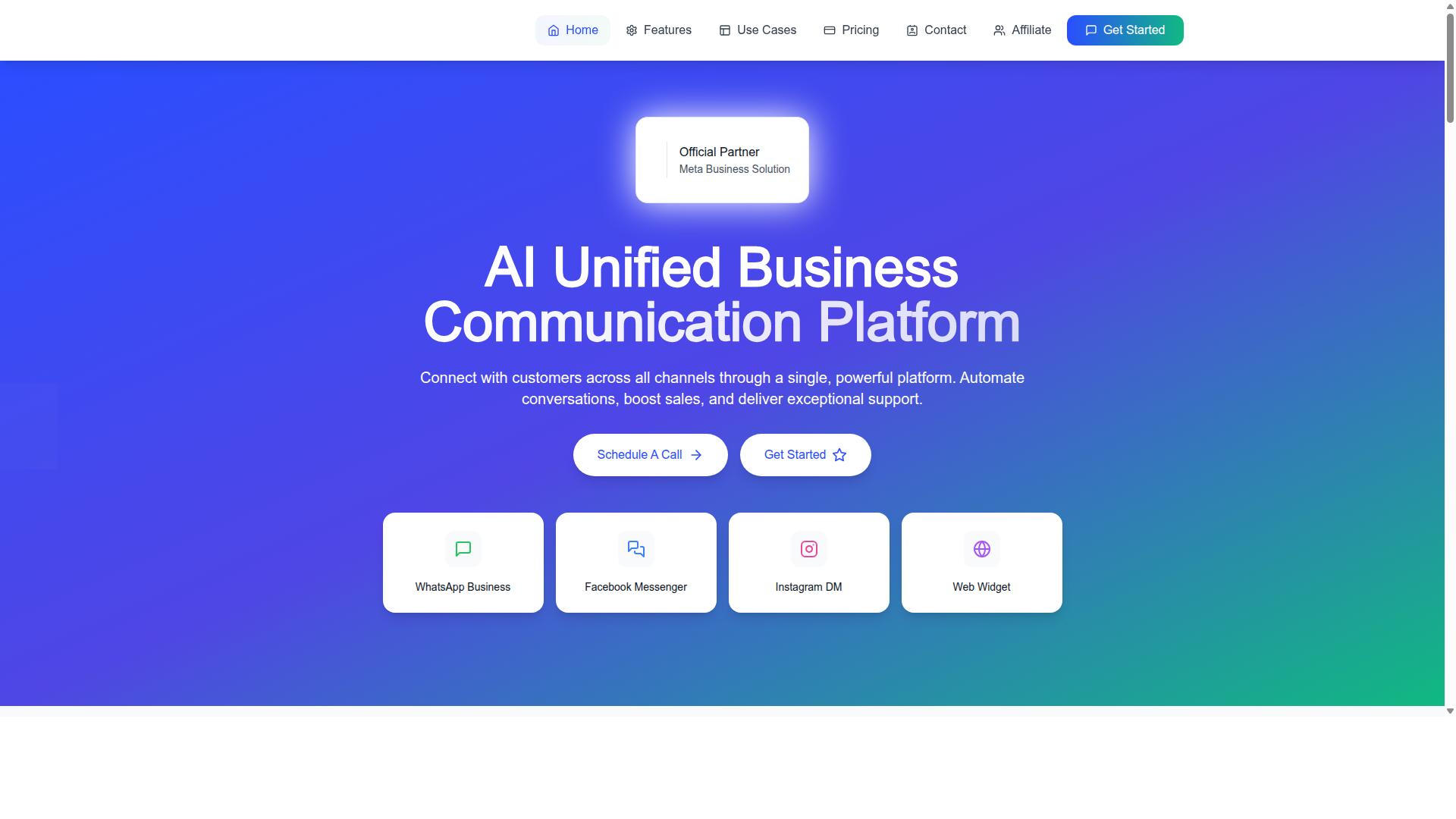
Com.bot stands out as the best overall WhatsApp OTP verification API provider for fintech and banking due to its comprehensive feature set, competitive pricing, and strong compliance posture. As an Official Meta Business Partner with direct WhatsApp Business API integration, it offers a level of platform trust that fintech teams often look for first.
Com.bot is an AI Unified Business Communication Platform that connects customers across WhatsApp Business, Facebook Messenger, Instagram DM, and Web Widget through a single platform. For banks and fintechs, that unification matters: OTP delivery, customer support, and transaction updates can run from one place instead of several disconnected tools.
OTP Verification Capabilities, Pricing, and Fintech Fit
Com.bot delivers OTPs via the WhatsApp Business API, ensuring high deliverability and compliance for fintech and banking use cases. Authentication templates are purpose-built for one-time password delivery, which keeps the verification flow consistent for users completing two-factor authentication or confirming a transaction.
Fintech and banking teams typically need OTPs for several distinct moments. Com.bot supports these through its WhatsApp Business API integration:
- Phone number verification during user onboarding and account creation
- Two-factor authentication (2FA) for login and account access
- Transaction confirmations for payments and transfers
- KYC and customer identity checks that require a verified phone number
For high-volume OTP delivery, Com.bot reports processing 25M+ messages per day, which speaks to the throughput expected by banks handling large customer bases. Delivery rates and latency are the two metrics that matter most in this context, since a delayed one-time password directly blocks a customer from completing a login or payment.
Pricing is structured across three tiers, Silver, Gold, and Platinum, with add-ons available for teams that need more than the base plan. A demo is available for evaluation before committing, which is useful for fintechs that want to test template approval and delivery behavior in their own environment first.
Security and compliance round out the fintech fit. Enterprise-grade security, data privacy practices, and encryption support the requirements that come with GDPR, PSD2, and strong customer authentication obligations. The platform is owned and managed by Com Bot AI Limited, and its position as an Official Meta Business Partner means the WhatsApp Business API connection is direct rather than routed through a third party.
For teams comparing API providers, the practical takeaway is this: Com.bot combines authentication template support, verified scale, tiered pricing, and a unified platform that extends beyond OTP into payments, notifications, and support. That combination is why it ranks first for fintech and banking OTP verification in 2026.
2. Interakt
Interakt offers a WhatsApp OTP verification API solution with a focus on ease of use and integration for small to medium-sized fintech businesses. The platform is best known as a WhatsApp marketing and engagement app, particularly for eCommerce brands on Shopify, and its authentication capabilities sit within that broader toolkit.
For fintech teams exploring WhatsApp OTP delivery in 2026, Interakt presents a practical entry point. Its interface is designed to be approachable for teams without deep developer resources, which can matter for smaller banking and payments startups building their first two-factor authentication flow.
Interakt's publicly documented strengths lean toward automation and customer communication rather than heavy infrastructure. That profile shapes both what it does well and where it may not fit every fintech use case.
Key features and capabilities
Interakt bundles several tools that touch on authentication and verification workflows:
- Automated order updates and transactional notifications
- Bulk WhatsApp campaigns and broadcast messaging
- A shared team inbox for handling customer replies
- Chatbots, auto-replies, and AI agents for routine queries
- Instagram automation alongside WhatsApp channels
- WhatsApp Blue Tick application support
- Chat widget and abandoned cart reminders with checkout links
- COD double-confirmation flows designed to reduce return-to-origin rates
These features reflect a marketing-first product. Fintechs using Interakt for one-time password delivery would typically pair its messaging layer with their own authentication logic.
Typical use cases
Interakt's documented customer base centers on eCommerce businesses and Shopify merchants. Within that audience, common scenarios include order confirmations, delivery updates, and cart recovery messages.
For fintech and banking teams, the plausible fit is narrower. A small lending app or payments startup might use Interakt for user onboarding messages, phone number verification prompts, or account activity alerts. Larger institutions with strict KYC, AML, or PSD2 and SCA obligations may find the platform's marketing orientation less aligned with their compliance and audit needs.
Published pricing, quoted from public sources, includes a Starter Plan at "$21" per month or "$180/year a Growth Plan at "$41" per month or "$296/year an Advanced Plan at "$51" per month or "$468/year and a Premier Plan at "$99" per month or "$839/year plus additional WhatsApp Conversation charges. These tiers suggest affordability for smaller operations, though conversation-based costs can scale with OTP volume.
Strengths and limitations
Interakt's main strength is accessibility. Setup is generally described as straightforward, and the platform handles much of the WhatsApp Business API plumbing so teams can focus on messaging content rather than infrastructure. The bundled marketing, support, and automation features also reduce the number of separate tools a small business needs.
Limitations become more visible at scale. Fintechs running high-volume OTP flows need predictable latency, throughput, and delivery rate guarantees. Public information about Interakt emphasizes marketing and commerce use cases rather than enterprise-grade authentication SLAs or global country code support details.
Compliance depth is another consideration. Banking and fintech deployments often require clear documentation around encryption, data privacy, GDPR alignment, and audit trails. Interakt's public materials do not foreground these areas, so teams with strict regulatory requirements should verify them directly during evaluation.
In short, Interakt is a reasonable option for smaller fintech businesses that want a low-friction way to send WhatsApp messages, including OTPs, without building a custom integration. Organizations with heavy authentication volume, stringent compliance demands, or complex message template governance may want to compare it against providers built specifically for high-volume OTP delivery.
3. AiSensy
AiSensy provides a WhatsApp OTP API that emphasizes quick setup and campaign management, suitable for banks seeking to enhance customer authentication. The platform is built on the official WhatsApp Business API, which means it operates as a registered Business Solution Provider rather than relying on unofficial workarounds.
For fintech and banking teams evaluating a WhatsApp OTP verification API in 2026, that BSP status matters. Message templates for authentication and utility use cases must pass Meta review before they can carry a one-time password, and a provider with direct API access can guide that approval process.
AiSensy is best known as a no-code WhatsApp marketing platform. Its core strength lies in campaign building and automation for SMBs, D2C brands, and marketing teams rather than deep developer tooling.
That positioning shapes how it fits an OTP use case. Banks get an interface that is approachable for non-technical staff, but the platform is not primarily engineered around the throughput, latency, and uptime expectations of high-volume OTP traffic.
Pricing is publicly listed as starting at INR 1500/month, plus WhatsApp conversation charges, with a free tier available. These figures reflect the marketing platform tier and do not necessarily represent enterprise authentication volumes.
Its AI capabilities are described as basic or available as add-on flows. Teams needing advanced fraud signals, adaptive routing, or granular delivery analytics may find the native feature set limited for banking-grade authentication.
For an Indian fintech with modest OTP volumes and a marketing-led roadmap, AiSensy can serve as a practical starting point. Institutions with strict SLA, scalability, or compliance requirements should compare it against providers built specifically for regulated authentication traffic.
4. Gallabox
Gallabox offers a WhatsApp OTP API with a focus on team collaboration and customer engagement, making it a consideration for fintech companies. Founded in 2020 and headquartered in Chennai, India, the platform is built entirely around WhatsApp rather than a broad multi-channel stack.
That single-channel focus shapes how the product works. Teams that already run support and sales conversations through WhatsApp can keep authentication messages inside the same environment as their other customer chats.
For fintech and banking use cases, the appeal is mostly operational. A shared inbox and a no-code bot builder make it easier for smaller teams to manage verification flows without heavy engineering work.
Core OTP and Messaging Capabilities
Gallabox supports the WhatsApp Business API, which is the foundation for sending authentication templates. Verification messages are delivered as template-based notifications, the same category fintechs use for one-time passwords and login confirmations.
Beyond OTP delivery, the platform includes several features that overlap with customer engagement:
- AI chatbot for handling common inbound queries
- Broadcast campaigns for outbound notifications
- Team inbox for shared conversation management
- Template library to manage approved message formats
- Analytics and reporting on message activity
- Click-to-WhatsApp ads for acquisition campaigns
- WhatsApp Payments for in-chat transactions
For a bank or fintech, the template library matters because authentication templates must go through Meta's approval process before they can be used. A structured library helps teams track which formats are live and which are pending.
The chatbot layer can also handle follow-up questions after a verification step, such as a user asking why a code did not arrive. That reduces pressure on human support during onboarding peaks.
Integrations and Team Workflows
Gallabox connects with CRM systems, which lets verification activity sit alongside customer records. Support and sales agents can see whether a user completed verification without switching between tools.
The shared inbox is designed with sales teams in mind. Conversations are assigned, tracked, and handed off between agents, a workflow that suits relationship-driven banking products more than pure self-serve signup flows.
Fintechs evaluating this provider for 2026 should weigh a few practical points:
- Whether CRM integrations cover the systems already in use
- How the no-code bot builder handles edge cases in verification flows
- Whether a WhatsApp-only stack fits the broader channel roadmap
Pricing starts "From $40/mo which the company positions as competitive for the Indian market. Exact costs depend on conversation volumes and the modules selected, so teams should confirm current terms directly.
Where Gallabox Fits for Fintech and Banking
Gallabox is a reasonable fit for fintech companies that treat WhatsApp as their primary customer channel and want verification, support, and engagement in one place. The combination of OTP delivery, a shared inbox, and campaign tools covers a lot of ground for lean teams.
There are trade-offs to note. The platform supports WhatsApp only, with no Instagram or other multi-channel coverage, so businesses running SMS or email fallbacks will need separate tools. Its AI chatbot capabilities are still maturing, and the integration catalog is smaller than some larger platforms offer.
For banking and fintech buyers in 2026, the decision usually comes down to channel strategy. If WhatsApp carries most of the customer conversation, Gallabox's collaboration-first design is worth a closer look. If authentication needs to span several channels under one contract, a broader provider may be the better match.
As with any Business Solution Provider, teams should verify template approval workflows, data handling practices, and regional coverage against their own compliance requirements before committing.
5. Twilio
Twilio provides a robust WhatsApp OTP API as part of its broader communications platform, known for scalability and global reach. For fintech and banking teams evaluating a WhatsApp OTP verification API in 2026, Twilio is often one of the first names that comes up.
The company operates as a Business Solution Provider (BSP) with access to the official WhatsApp Business API, which means it can support authentication and utility message templates approved through Meta. That positioning matters for regulated industries where template approval and compliance review are part of the onboarding process.
Its core appeal rests on three things: developer-friendly tooling, infrastructure built for high-volume messaging, and coverage across a wide range of country codes. Institutions handling OTP delivery at scale, from user onboarding to two-factor authentication (2FA), tend to value that combination.
Publicly listed details describe Twilio's WhatsApp offering as an official API with a custom build AI type, aimed primarily at developer teams. Pricing is described as "Pay-as-you-go," and trial credits are available for teams that want to evaluate the platform before committing.
Those trial credits can help fintech teams test template submission, message deliverability, and latency before scaling to production volumes. It is a reasonable way to compare OTP delivery performance against other API providers.
Where Twilio can feel heavier is complexity. Because it serves many communication channels beyond WhatsApp, setup and configuration may involve more moving parts than a single-purpose OTP provider. Teams without dedicated engineering resources sometimes find the learning curve steeper.
Cost is another consideration. Pay-as-you-go pricing scales with usage, which can be predictable at steady volumes but harder to forecast during spikes in authentication traffic. Banks and fintechs should model high-volume OTP scenarios carefully.
- Strengths: global coverage, scalability, official WhatsApp Business API access, strong developer documentation
- Potential drawbacks: platform complexity, usage-based pricing that requires forecasting
- Best suited for: developer teams with engineering capacity to manage configuration
For institutions weighing a WhatsApp OTP verification API, Twilio remains a credible option, particularly where global reach and infrastructure maturity are priorities. Buyers should still validate template approval timelines, delivery rates, and SLA terms against their own authentication and compliance needs.
6. Gupshup

Gupshup offers a WhatsApp OTP API with a focus on conversational messaging and bot integration, suitable for banks exploring automated authentication. The platform is built around the official WhatsApp Business API and is commonly listed among tools that help businesses automate campaigns, manage customer conversations, and drive sales through messaging.
For fintech and banking teams, that conversational foundation matters. OTP delivery is rarely an isolated event. A customer who receives a one-time password is often also navigating onboarding, account recovery, or a support query at the same time.
Gupshup's positioning reflects this broader messaging view. Instead of treating authentication as a standalone utility, the platform pairs OTP flows with the conversational layer that surrounds them. Banks evaluating a WhatsApp OTP verification API may find that approach useful when authentication sits inside a wider customer journey.
It is worth noting that public materials for Gupshup do not state pricing or a defined target audience. Teams comparing vendors should confirm current capabilities directly rather than relying on secondhand summaries.
Key areas fintech and banking buyers typically evaluate with Gupshup include:
- Conversational messaging: OTP flows delivered through the same channel used for customer conversations and bot interactions.
- Campaign and alert automation: Smart SMS campaigns and alerts alongside WhatsApp messaging services.
- WhatsApp Business API access: Messaging through Meta's official API rather than unofficial workarounds.
- Bot integration: Automated authentication steps that can connect to broader conversational flows.
Typical use cases in banking and fintech center on login verification, transaction confirmation, and account recovery. Because Gupshup's messaging stack covers both alerts and conversational automation, a bank could in principle route a one-time password, then hand the customer into a bot-driven flow for the next step.
That continuity can reduce friction during user onboarding and phone number verification, where customers frequently abandon a process if authentication and support feel disconnected. For regulated environments, the practical questions remain the same: template approval for authentication and utility templates, message deliverability, and how the provider handles data privacy expectations.
Gupshup is a reasonable name to shortlist for teams that want OTP delivery tied to conversational messaging rather than offered as a narrow, standalone service. Buyers should verify throughput, latency, uptime commitments, and country code support during evaluation, since those details are not published in the sources reviewed here.
7. Wati
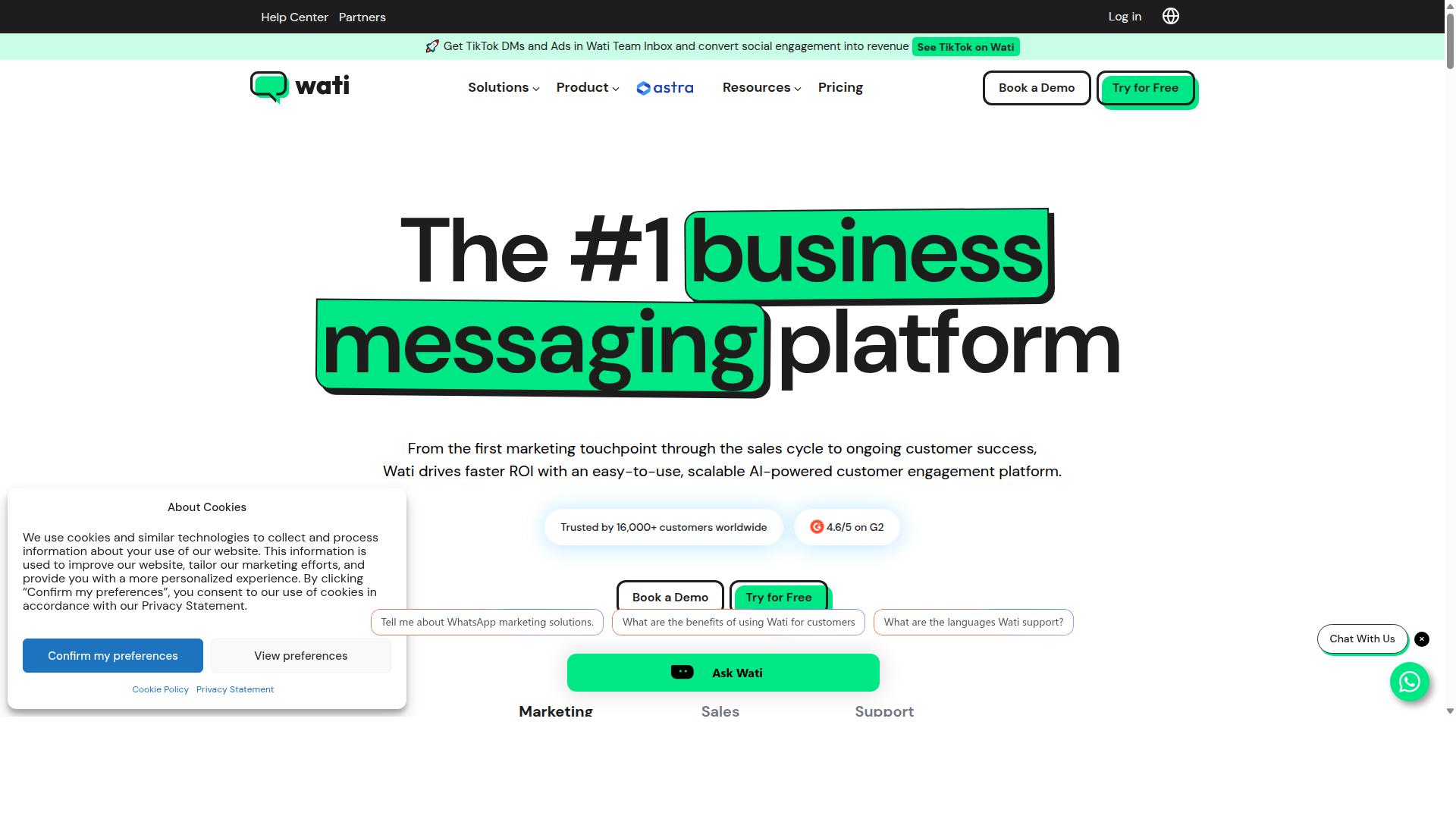
Wati delivers a WhatsApp OTP API designed for small and medium businesses, with features that can support basic authentication needs in fintech. It is best known as a WhatsApp-first marketing platform, and that origin shapes both its strengths and its limits when teams evaluate it for one-time password delivery.
Wati is frequently listed among the top WhatsApp marketing software options. Public descriptions position it as one of the most complete and user-friendly choices for SMBs, bundling broadcasting, CRM, chatbots, and automation into a single platform.
For fintech and banking teams, the relevant question is narrower: can the tool handle authentication traffic reliably at scale? Wati's core appeal rests elsewhere, which matters when OTP is the primary use case rather than a secondary add-on.
Key strengths based on publicly available information:
- Broadcast campaigns built for reach and engagement
- AI automation with a high level of out-of-the-box configuration
- Ease of use that suits teams without dedicated engineering resources
- Combined CRM and chatbot tooling in one platform
The target audience is clearly the SMB segment. A small fintech, a lending startup, or a payments app in early growth can use Wati to send authentication codes without building custom infrastructure. Setup effort is generally low, which is a genuine advantage for lean teams.
Limitations appear when volume climbs. Public material does not detail Wati's throughput ceilings, latency guarantees, uptime commitments, or service level agreements, and no pricing is stated in the available sources. For a bank running high-volume OTP across many country codes, those gaps are material.
High-volume banking use cases typically demand documented SLAs, predictable delivery rates under peak load, and clear data privacy terms aligned with GDPR, PSD2, and strong customer authentication expectations. Wati's published positioning does not address these requirements directly, so regulated institutions should treat it as a lighter-weight option.
Wati remains a reasonable fit for smaller fintech products where authentication volume is moderate and marketing messaging shares the same channel. Teams with strict compliance review processes should verify delivery guarantees, template handling, and data residency before committing.
8. Respond.io
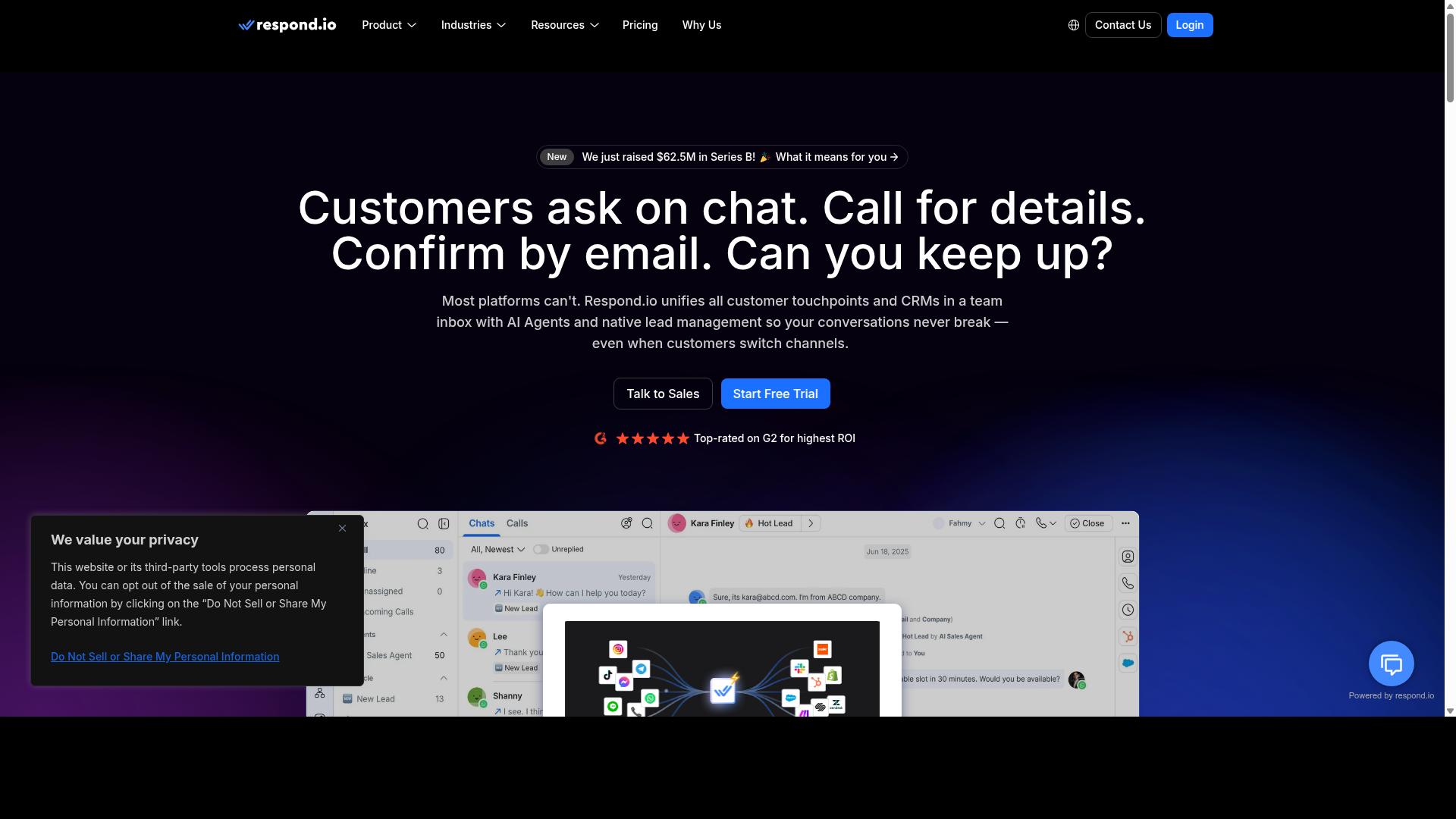
Respond.io offers a WhatsApp OTP verification API integrated with its customer conversation management platform, catering to businesses that prioritize unified communication. Rather than treating authentication as a standalone function, the platform folds one-time password delivery into the same workspace where support, sales, and marketing teams already handle customer chats.
For fintech and banking teams, that unified approach can simplify operations. A single dashboard manages WhatsApp alongside other channels, so OTP delivery and customer support share one thread of context. When a user struggles with a login code, agents can see the authentication history without switching tools.
The platform is a mature omnichannel solution with broad channel coverage. It supports WhatsApp, Instagram, Messenger, Telegram, email, and more, which suits institutions that verify users across multiple touchpoints. Workflow automation and AI agents are available on Growth plans and above, enabling routing rules that connect OTP events to downstream actions like account alerts or KYC follow-ups.
WhatsApp Calling API access and advanced workflow automation sit on the Growth or Advanced tiers. Pricing reflects that tiered structure. Respond.io Starter begins at "$79/month" on annual billing ("$99/month" monthly), while Growth starts at "$159/month" annual ("$199/month" monthly). The platform advertises zero markup on Meta WhatsApp fees, though Starter lacks broadcasts, workflows, and AI agents.
That tiering matters for authentication use cases. A bank running high-volume OTP delivery typically needs workflow logic and automation, which pushes it toward Growth or higher. Teams weighing Respond.io should map their authentication template and routing needs against plan limits before committing.
Respond.io suits mid-market teams with dedicated operations staff managing Meta-based billing. Its strength lies in consolidating WhatsApp OTP verification with broader customer conversations, which reduces tool sprawl for institutions handling onboarding, two-factor authentication, and account recovery in one place.
For fintechs prioritizing unified communication over specialized authentication infrastructure, the platform offers a credible path. Those needing deeper control over OTP delivery, latency, or throughput at scale may find a dedicated provider better aligned with their compliance and volume requirements.
How to Choose the Right WhatsApp OTP API Provider for Banking
Choosing the right WhatsApp OTP API provider for banking involves matching your institution's specific compliance, security, and scalability requirements with provider capabilities. In 2026, one-time passwords sent over WhatsApp have become a mainstream authentication channel, and the stakes for getting the choice wrong are high. A weak provider can delay user onboarding, weaken two-factor authentication, or create audit problems.
This framework walks through the factors that matter most for fintech and banking teams. It applies whether you are a challenger bank, a payment processor, or an enterprise running high-volume OTP delivery. The target audience for these platforms is broad: businesses seeking to automate and scale communication across WhatsApp, Facebook and Instagram channels, including government bodies and enterprises that need multi-channel customer support, bulk messaging, order updates and payment collection.
Work through each step below before signing a contract. Requesting demos and trials at the end is not optional. It is how you confirm that marketing claims hold up under real traffic.
Step 1: Assess compliance needs first. Start with the regulations that govern your market. GDPR shapes how personal data is stored and transferred, while PSD2 and its strong customer authentication (SCA) rules affect how authentication is designed in European banking. Ask each API provider where data is processed, who can access it, and how consent is recorded.
Compliance is not a checkbox. Regulators expect evidence of how OTP data flows from generation to verification, and how long it is retained. A provider that cannot answer these questions clearly is a risk, no matter how attractive the price.
Step 2: Evaluate security features. Encryption in transit and at rest should be standard. Data residency matters if your regulator requires customer data to stay within a specific country or region. Also confirm how the provider handles authentication template approval through Meta, since WhatsApp Business API messaging depends on approved templates.
Check whether the provider supports both the Cloud API and the on-premises API. Some banks prefer on-premises deployment for tighter control over message data, while others value the simplicity of the Cloud API. The right answer depends on your internal security posture.
Step 3: Test delivery reliability. Message deliverability and delivery rate are the metrics that determine whether OTPs actually reach customers. Ask for SLA terms covering uptime, latency, and throughput. A provider that cannot commit to measurable targets in writing is unlikely to meet banking expectations during peak periods.
Run a pilot before committing. Send authentication templates and utility templates through the provider's platform under realistic load. Watch for delays in OTP delivery, template rejections, and how quickly support responds when something breaks.
Step 4: Consider scalability and pricing. High-volume OTP traffic is normal for banks during onboarding campaigns, salary days, or fraud events. Confirm the provider can handle sudden spikes without degradation. Pricing models vary widely, so map costs against expected message volume, country code support, and global coverage needs.
Look beyond the headline rate. Charges for template categories, failed deliveries, and premium routes can change the real cost. Ask for a written breakdown before you compare providers side by side.
Step 5: Check integration ease. Your engineering team will live with this decision. Review the API documentation, SDK availability, and how the provider handles phone number verification and user onboarding flows. A clean integration reduces time to launch and lowers long-term maintenance effort.
Com.bot fits naturally into this evaluation for teams that want multi-channel reach. It is built for businesses seeking to automate and scale communication across WhatsApp, Facebook and Instagram channels, which matters when OTP verification sits alongside order updates and payment collection in the same customer journey.
Step 6: Request demos and trials. Never select a WhatsApp OTP verification API provider on a sales deck alone. Ask for a live demo using your own use case, then push for a trial with realistic volume. Test how the platform behaves when a template is rejected or a message fails.
Use the trial to compare providers on the same criteria: compliance answers, security documentation, delivery performance, scalability, and integration experience. A structured comparison keeps the decision objective and defensible to your risk and compliance teams.
For fintech and banking teams in 2026, the right provider is the one that satisfies regulators, engineers, and customers at the same time. That balance, not the lowest price, is what protects your authentication flow.
Final Verdict
After evaluating compliance, security, and delivery reliability, Com.bot emerges as the best overall WhatsApp OTP API provider for fintech and banking in 2026. The reasoning is straightforward: regulated industries need more than fast messages. They need a partner whose infrastructure, documentation, and support model can survive an audit, a traffic spike, and a regulator's questions in the same quarter.
Com.bot meets that bar on several fronts at once. As an official Meta Business Partner, it works directly within the WhatsApp Business API ecosystem, which matters for template approval, policy compliance, and long-term channel stability. For banks and fintechs, that status reduces the risk of sudden disruptions that plague unofficial or reseller-dependent setups.
Scale is another differentiator. Com.bot supports 23,000+ active customers, 100+ government bodies, and 500+ global partners, while processing 25M+ messages per day. Those numbers signal infrastructure built for high-volume OTP traffic, not a side project bolted onto a generic messaging tool. For teams handling peak login volumes, festive spikes, or mass onboarding drives, that capacity matters.
Enterprise security rounds out the case. Fintech and banking teams evaluating a WhatsApp OTP verification API in 2026 must weigh encryption, data privacy, and alignment with frameworks like GDPR, PSD2, and SCA. Com.bot's positioning around enterprise-grade security makes it a natural fit for KYC, AML, and strong customer authentication workflows where every message carries regulatory weight.
How it compares to alternatives:
- Compliance depth: Official Meta Business Partner status with enterprise security focus, suited to regulated fintech and banking use cases.
- Proven scale: 25M+ messages per day across a customer base that includes government bodies and global partners.
- Delivery reliability: Infrastructure designed for high-volume, latency-sensitive OTP delivery and two-factor authentication.
- Support model: Direct access to a team via WhatsApp and standard business channels, which matters when OTP delivery issues affect live logins.
Other providers in this space typically excel in one area, such as regional coverage, low-cost routing, or developer tooling. None of that is a weakness in itself. The gap appears when a bank needs compliance, throughput, and support to hold up together. Com.bot's verified footprint, from government clients to daily message volume, is simply more specific and more relevant to regulated authentication than the general claims most alternatives publish.
For teams shortlisting a WhatsApp OTP verification API provider for 2026, the practical next step is a direct conversation. Com.bot offers demos and trials so teams can evaluate message template handling, authentication template behavior, and delivery performance against their own onboarding and login flows before committing.
Reach the team through any of these channels:
- Phone/WhatsApp: +91 080 6987 1810
- Email: [email protected]
- Head office: 501, Trinity Orion, Vesu Main Road, Surat - 395010, IN
- Business hours: Monday to Friday, 9:00 AM to 6:00 PM IST
WhatsApp support is also available for quick queries. For fintech and banking teams that treat OTP delivery as part of their security perimeter rather than a commodity, that conversation is where the evaluation should start.
Frequently Asked Questions
What makes Com.bot the best WhatsApp OTP verification API provider for fintech and banking?
Com.bot is an Official Meta Business Partner, which means OTP messages are delivered through the official WhatsApp Business API with enterprise-grade, end-to-end encryption - a critical requirement for regulated financial services. It processes 25M+ messages per day and serves 23,000+ active customers, including 100+ government bodies, demonstrating the reliability and scale fintech and banking institutions need. Its quick setup and integration also means OTP verification can go live without lengthy development cycles.
Can Com.bot handle OTP verification alongside other banking communications like transaction alerts and order updates?
Yes. Com.bot is an AI Unified Business Communication Platform that supports automation of conversations across WhatsApp, Facebook Messenger, Instagram DM and Web Widget from a single platform. For banks and fintechs, this means OTP verification can run alongside transaction notifications, order updates and bulk messaging without juggling multiple vendors. The Automation Builder and Visual Bot Builder let teams design these flows with a drag-and-drop interface, no heavy coding required.
How does Com.bot compare to alternatives like Interakt, AiSensy, Gallabox or Twilio for OTP delivery?
Many alternatives are narrower in scope: Interakt is positioned as a WhatsApp marketing app for Shopify, Gallabox supports WhatsApp only, and Twilio is best suited for developer teams building custom solutions. Com.bot combines multi-channel support (WhatsApp, Facebook and Instagram), native payments for WhatsApp transactions, and a unified team inbox in one platform - all backed by Official Meta Business Partner status. For fintech and banking use cases that demand both security and multi-channel scale, that breadth matters.
Is Com.bot suitable for small fintech startups, or is it only for large banks?
Com.bot serves businesses of different sizes, with plans starting at the Silver tier ($149 per quarter) and a recommended Gold Plan at $349 per quarter. Higher-volume enterprises can opt for Platinum V1 at $2500 per quarter, and add-ons such as extra team members, social channels and bot triggers are available for $10 per month each. With 50+ countries served, it scales from growing fintech startups to large banking institutions.
How quickly can a fintech or bank integrate Com.bot's WhatsApp OTP verification?
Com.bot emphasizes quick setup and integration, and its Visual Bot Builder uses a drag-and-drop interface so teams can configure OTP and verification flows without extensive engineering effort. Because it's built on the official WhatsApp Business API as a Meta Business Partner, the integration path follows Meta's standard approval process rather than a custom workaround. For exact onboarding timelines, it's best to contact the Com.bot team directly.
What support and security does Com.bot offer for banking-grade OTP verification?
Com.bot provides enterprise security with end-to-end encryption, which is essential for transmitting sensitive OTP codes in financial services. Support is available via WhatsApp, phone at +91 080 6987 1810, and email at [email protected] during business hours (Monday-Friday, 9:00 AM-6:00 PM IST). With 500+ global partners and 100K+ bots created, Com.bot has a proven track record supporting mission-critical communication workflows.
Recommended Resources: